· Alex Mac · Development · 6 min read
Strategic Empathy: Rehumanising Project Governance
Reflections from a BCS webinar on Strategic Empathy and how noticing weak signals can transform project governance from hindsight to foresight.
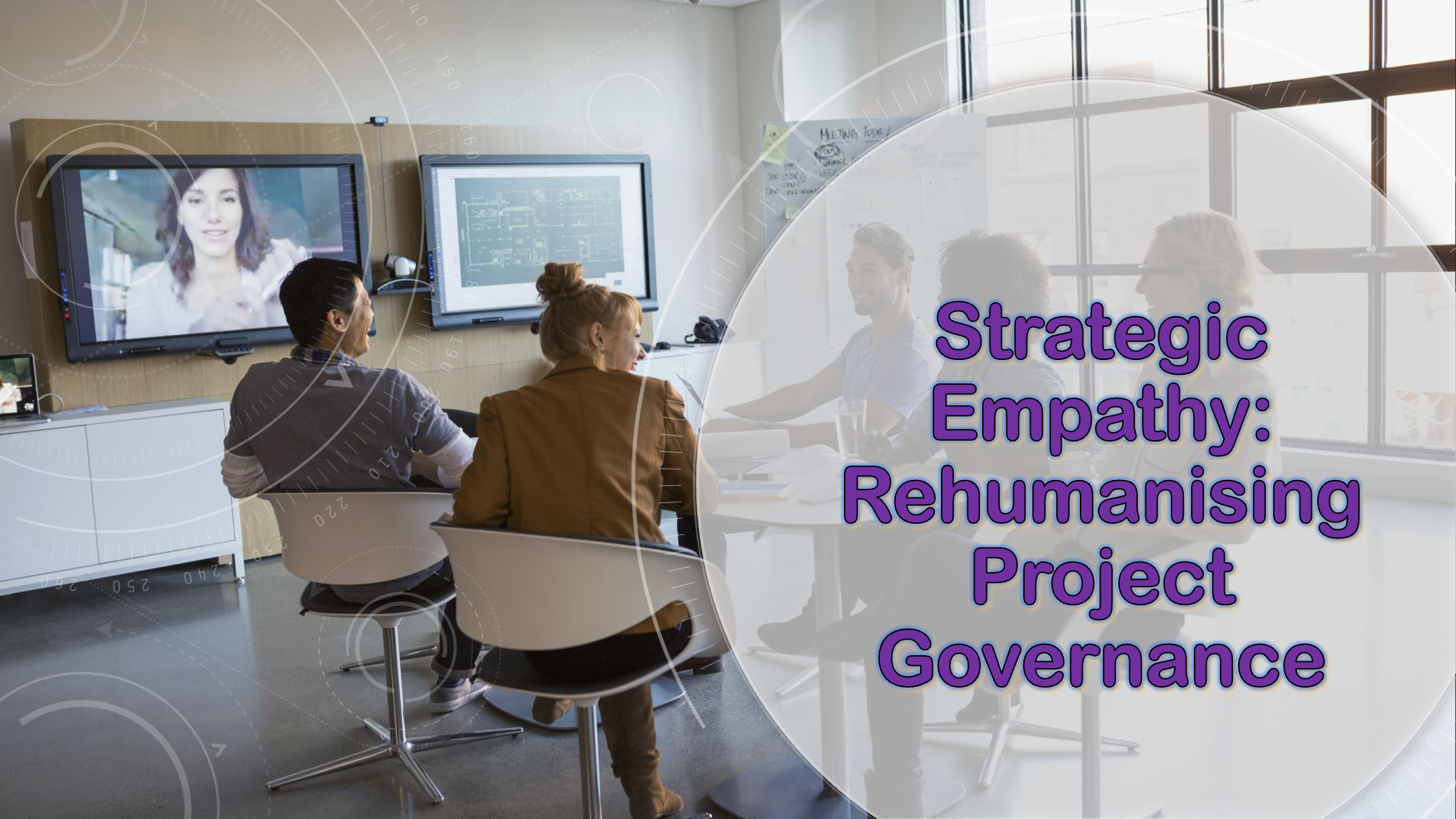
On 19th February 2026, I attended a thought-provoking webinar hosted by BCS PROMS-G called Strategic Empathy: Rehumanising Project Governance.
This interesting webinar, presented by Eleonora Cao, challenged many of the traditional assumptions I held around governance, reporting and how projects actually fail. Rather than focusing on processes or frameworks alone, the session explored something deeper: how organisations interpret reality and, more importantly, how often they fail to notice it while it is still changing.
The Illusion of Control in Project Governance
One of the most striking takeaways of this webinar was the idea that projects rarely fail suddenly. They fail slowly, often while dashboards remain green and reporting appears reassuring.
This happens because:
- Strategies are strong, but certain difficult trade-offs are often avoided
- Reporting can end up replacing operational truth
- Incentives reward looking in control rather than actually being in control
- PMOs can sit too far from the actual delivery reality
- Risks are often only recognised once they start to become measurable
In other words, governance systems can unintentionally sanitise the reality of the situation. By the time any issues become visible in quantitative data, the environment has already shifted and the options to remedy them has reduced.
The Governance Gap Between Leadership and Delivery
A particularly powerful concept discussed was the governance gap.
Leadership may see:
- Clean reports
- Green RAG statuses
- No formal escalations
Meanwhile, the delivery teams might be experiencing:
- Friction
- Workarounds
- Weakening assumptions
- Informal escalations that never fit into any governance templates
Both perspectives can be true at the same time. The issue is not necessarily dishonesty, but more like a form of filtering. Weak signals that are “too subjective”, “not measurable yet”, or “out of scope” often end up getting lost before they reach the decision-makers.
This reframed how I think about project reporting: not as a neutral mirror of reality, but as a structured interpretation of reality.
Strategic Empathy and the Power of Noticing
At the core of the webinar was the idea of strategic empathy: the ability to notice early signals while reality is still in motion, rather than reacting only after variance appears in the data.
Projects operate within a constant flux, yet governance is often a static aspect. An analogy given within the webinar to describe this was:
Reality of projects change constantly like the flow of a river, whereas governance is like fitting a square plug into a round hole - you need to shave off the edges to make it fit.
With governance there exists ‘sharp edges’, such as friction, hesitation and repeated workarounds, which are not noise but represent weak signals of drift that form beneath the surface in projects.
Noticing these signals requires attention. A quote from Richard P. Feynman was given in the session:
Knowledge isn’t free, you have to pay attention!
This idea deeply resonated with my own academic and professional journey, especially as I move further into project and governance-focused roles.
Sensemaking, Hindsight and Acting Too Late
The webinar referenced Karl Weick’s Sensemaking Theory, highlighting that organisations often make sense of events retrospectively.
By the time we fully understand what went wrong:
- Assumptions have already weakened
- Options have already collapsed
- Decisions become reactive rather than strategic
This links closely to the Cassandra Effect, where you can see future risks forming, but are not believed or the urgency of what is to come is underestimated because the evidence is not yet quantifiable.
This made me reflect on how often governance frameworks prioritise certainty over awareness, as well as linking with Teece’s Dynamic Capabilities Theory and other areas during my studies of my MSc in Technology Management that highlights how innovation and progress often requires the ability to ‘sense’, ‘seize’ and ‘reconfigure’, even when faced with elements of uncertainty.
Where Early Warning Signals Go to Die
One of the most practical insights was how weak signals are filtered out across governance layers.
Weak signals typically appear as:
- Friction in processes
- Hesitation in decision-making
- Repeated workarounds
- Hidden effort to keep progress stable
However, they are often dismissed because they are:
- Qualitative rather than quantitative
- Inconvenient
- Not yet measurable
As a result, reports reassure stakeholders while drift continues to accumulate quietly in cost, delay and trust.
From Reporting Factory to Sensemaking Engine
Another compelling discussion point was the evolution of the Project Management Office (PMO).
Traditional PMOs often operate as:
- Reporting-led
- Template-driven
- Retrospective in assurance
Whereas a strategic empathy-enabled PMO would be:
- Sensemaking-led
- Focused on signal amplification
- Testing assumptions early
- Framing decisions before consequences escalate
Importantly, this does not mean abandoning reporting. Instead, it means adding a layer that interprets information, rather than simply aggregating it.
Acting Before Failure Becomes Measurable
A recurring theme throughout the webinar was that time removes optionality.
Early in a project, there may be multiple viable paths that can be taken, however as reality shifts and uncertainty is ignored:
- Decisions are deferred
- Monitoring replaces intervention
- Variances eventually appear
- Options become limited or costly to reverse
Strategic empathy encourages earlier intervention through:
- Drift reviews
- Explicit assumption testing
- Pause authority on key decisions
- Governance adjustments while flexibility still exists
This felt particularly relevant in environments where progress is maintained through hidden strain rather than sustainable stability.
Questions Dashboards Cannot Answer
One of the most reflective sections within the webinar focused on the Cultuval and behavioural questions governance should be asking:
- Where are people compensating to keep progress stable?
- Which assumptions are quietly weakening?
- Where is adaptation happening without formal authority?
If progress is being maintained through overtime, workarounds, or ‘heroic effort’, then it may not actually be true progress and be a form of accumulating debt.
This insight challenged my own perception of what ‘on track’ really means in project contexts.
Why Strategic Empathy Is Difficult in Practice
Despite its value, the webinar acknowledged why strategic empathy is hard to implement:
- It requires acting before proof exists
- It exposes uncomfortable truths about power and decision-making
- It disrupts the comfort of polished reporting
- It asks leaders to intervene under uncertainty
Strategic empathy was described as not being soft, but instead being difficult because it demands honesty and attentiveness rather than procedural compliance.
Personal Reflections and Professional Relevance
As someone currently transitioning further into project and governance-focused roles, this webinar felt especially timely.
It reinforced several lessons I’ve been experiencing in my own academic studies and professional development:
- Governance should support reality, not obscure it
- Qualitative insight is as important as quantitative data
- Early noticing is a leadership capability, not just a process
- Reflection should be seen as an enabler, not a delay
The idea of moving from hindsight-driven governance to foresight-oriented sensemaking aligns strongly with my growing interest in project management, organisational behaviour and strategic decision-making.
Final Thoughts
The webinar ultimately reframed governance not as a rigid control mechanism, but as a living system that must evolve alongside the project environment it operates within.
Strategic empathy does not provide more data - it changes what we choose to see, listen to and act upon.
2025 was a year where I learned resilience through experience and attending this session in early 2026 felt like a reminder that awareness, especially of weak signals and shifting realities, is what enables us to make better decisions before the consequences become unavoidable.
In a world of increasing complexity and rapid technological change, rehumanising governance through attention, interpretation and timely intervention may be one of the most valuable capabilities a project professional can develop.